Hotel suppliers compete in one of the hardest B2B markets. Procurement is decentralized across owners, brands, management companies, and third-party design firms. Decision cycles span months. Trade-show booths cost $30,000+ for a few weeks of conversations. And the buying calendar is project-driven — you’re either in front of a decision-maker during their renovation window or you’re invisible until the next one in seven years.
Most suppliers respond to this complexity by doubling down on the same playbook: bigger trade-show booths, more cold calls, more “Visit our showroom in High Point” emails. The suppliers winning right now are doing the opposite — building always-on lead generation systems that catch hotels at the precise moment they’re specifying products, not when a salesperson happens to call.
This is the pillar guide. It maps twelve lead generation strategies that move pipeline for hotel product suppliers, each one linked to a deeper tactical playbook where one exists. Read it as an operating system, not a checklist. The suppliers compounding the fastest run six to eight of these in parallel — not all twelve, but enough to cover discovery, engagement, and follow-up across every buyer behavior.
The Hotel Buyer’s Journey Has Already Gone Digital
Before the strategies, the context. Hotel procurement teams research suppliers online before they request proposals. According to industry surveys, 94% of procurement executives use AI tools weekly for vendor research, and 69% of hotel technology budgets are now allocated to software-driven decision support. The implication: when a procurement director needs a new linen vendor or a renovation team needs FF&E for a 200-room conversion, they’re typing search queries into Google before they’re walking trade-show aisles.
That shift breaks the old supplier playbook. A booth at Equip’Hotel or HD Expo will produce conversations, but the buyer who Googles “hotel linen suppliers wholesale Europe” at 11pm on a Tuesday won’t be at your booth. Your job is to be in both places — the show and the search results — without doubling your sales budget.
The twelve strategies below break into four phases: discovery (how buyers find you), engagement (how you reach them first), conversion (how meetings turn into POs), and compounding (how each win generates the next).
Phase 1: Discovery — Be Found Before They Search You
Strategy 1: SEO for Buyer-Intent Keywords
Hotel procurement professionals search Google before they search trade-show floors. The supplier ranking on page one for “hotel linen suppliers bulk orders” or “commercial hotel furniture manufacturers” wins the visibility war. Most hotel supplier websites are brochure-ware — basic product pages, a contact form, no keyword strategy. That gap is the opportunity.
The strategy that works: identify 30-50 commercial-intent keywords your buyers actually search, build dedicated product and category pages targeting each, then layer in supporting content that answers procurement questions (“How long does hotel furniture take to manufacture?” “What’s the difference between commercial-grade and contract-grade upholstery?”). Track rankings monthly and double down on the keywords moving toward page one.
For the full tactical playbook — keyword research, product page optimization, technical SEO, and the content marketing layer — see SEO for Hotel Supply Companies: Rank for Buyers.
Strategy 2: Content Marketing That Procurement Reads
Trade-show conversations are forgotten in a week. A well-written guide on “How to Specify Hotel Bath Amenities for Brand Standards” stays indexed for years and generates leads every time a procurement director searches for it.
Hotel supply content marketing isn’t blog filler. It’s executive-level technical writing: specification guides, comparison frameworks, certification explainers, and case studies that procurement teams forward internally when they’re building shortlists. Suppliers who publish 8-12 substantive pieces per year — each 1,800+ words and answering a specific buyer question — see compounding traffic and inbound inquiries within 6-12 months.
For the publishing framework, topic clusters, and content distribution playbook, see Content Marketing for B2B Hotel Supply: What to Write & Publish.
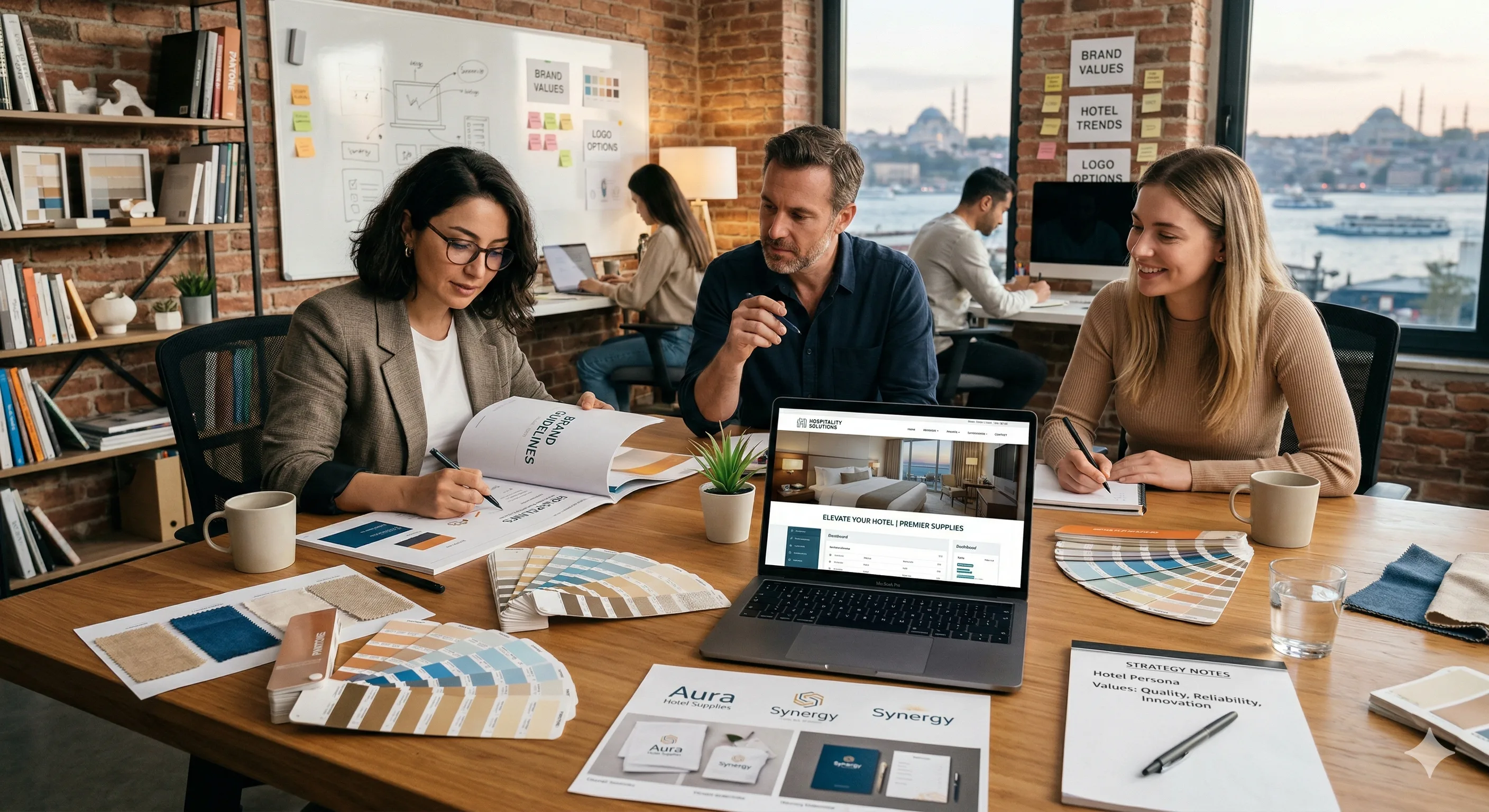
Strategy 3: Brand Building as a Long-Term Multiplier
Hotel suppliers underinvest in brand. The ones who don’t — Sferra, Frette, Standard Textile, Hansgrohe — extract higher prices, win more specifications, and weather price-pressure cycles better than commodity competitors. Brand isn’t a logo; it’s the cumulative perception that procurement teams hold about your reliability, quality, and category leadership before they ever talk to your sales team.
The 12-month brand-building plan covers digital presence (website, LinkedIn, industry directories), thought leadership (founder POV, technical authority), media positioning (industry publications, podcast appearances), and design-firm relationships (the highest-leverage brand multiplier in luxury hotel work).
For the channel-by-channel implementation plan, see Building a Hotel Supplier Brand Online: The Digital Playbook.
Phase 2: Engagement — Reach the Right People First
Strategy 4: LinkedIn for Procurement Decision-Makers
LinkedIn is where hotel procurement directors, F&B purchasing managers, and FF&E specifiers list their roles, post their RFPs (sometimes), and signal their job changes. For B2B hotel supply, it’s the single most effective channel for reaching named decision-makers without buying a contact database.
The tactical playbook covers profile positioning (so when buyers research you, your profile reinforces credibility), advanced search filters that surface procurement leads at specific brands, content cadence that builds inbound interest, and outreach sequences that get responses from people who actually sign POs. Most hotel suppliers use LinkedIn passively — broadcasting product photos to other suppliers. The ones who win use it as targeted outbound combined with credibility-building content.
For the full LinkedIn approach including search queries and message templates, see LinkedIn for Hospitality Suppliers: Reach Procurement Decision-Makers.
Strategy 5: AI-Powered Renovation Signal Monitoring
The single highest-ROI strategy in 2026 is also the newest. Hotels announce renovations, brand conversions, new builds, and PIP-driven refurbishments in dozens of public sources every day — industry publications, brand press rooms, LinkedIn appointment announcements, construction permit filings, RFP databases, and design-firm portfolio updates. Reading them all manually is impossible. Reading them automatically is the difference between reaching a procurement director on day one of their RFP and showing up after the contract is signed.
AI signal monitoring tools (including platforms like InnLead.ai purpose-built for hotel suppliers) scan these sources continuously, extract structured intelligence — property name, scope, timeline, product categories needed — and match it against your catalog. The supplier who reaches a hotel within 48 hours of the renovation being announced has a 5-10x higher response rate than the supplier who reaches them three months later when every competitor has already made contact.
This is the strategy most hotel suppliers haven’t operationalized yet. The window of competitive advantage is open — but closing fast as more suppliers adopt the workflow.
Strategy 6: Targeted Cold Email and Outbound Sequencing
Cold email still works in hotel supply — but only when it’s targeted, personalized to the recipient’s actual project, and sent from a domain with real reputation. The mistake most suppliers make is mail-merging “Dear procurement professional” blasts to scraped lists. Deliverability tanks, replies plummet, and the domain reputation damage takes months to repair.
Effective outbound combines verified contact data (procurement directors at named brands, not generic “info@” addresses), trigger-based messaging (you’re reaching out because of a specific renovation, brand conversion, or GM change at this property), and a multi-touch sequence over 3-6 weeks. The benchmark for hotel-supply outbound is 5-8% reply rates on a tight ICP and 1-2% meeting-booking rates — physical-goods cycles are slower than SaaS, but deal sizes are 10-100x larger.
Pair cold outbound with the procurement contact research playbook covered in How to Find Hotel Procurement Contacts and Decision-Makers so you’re emailing the right person from day one.
Strategy 7: Trade Shows — Strategic, Not Default
Trade shows still produce real conversations and the kind of in-person trust that closes seven-figure FF&E contracts. They are not dead. But they are no longer the default channel — and treating them as one wastes budget that would compound better elsewhere.
The economics: a single trade-show booth at HD Expo, BDNY, Equip’Hotel, or HICAP runs $30,000-80,000 all-in (booth, travel, samples, freight, staff time). For that money, you’ll have 50-150 substantive conversations and walk away with maybe 10-20 qualified leads. Compare that to a year of SEO+content+signal-monitoring at $30,000-60,000 producing 500-1,500 inbound or trigger-based qualified opportunities.
The strategic move: pick 1-2 trade shows per year where your specific buyers are, invest deeply in those (custom appointments booked in advance, hosted dinners, design-firm outreach beforehand), and skip the rest. Use the saved budget to fund the always-on digital channels.
Phase 3: Conversion — Turn Meetings Into POs
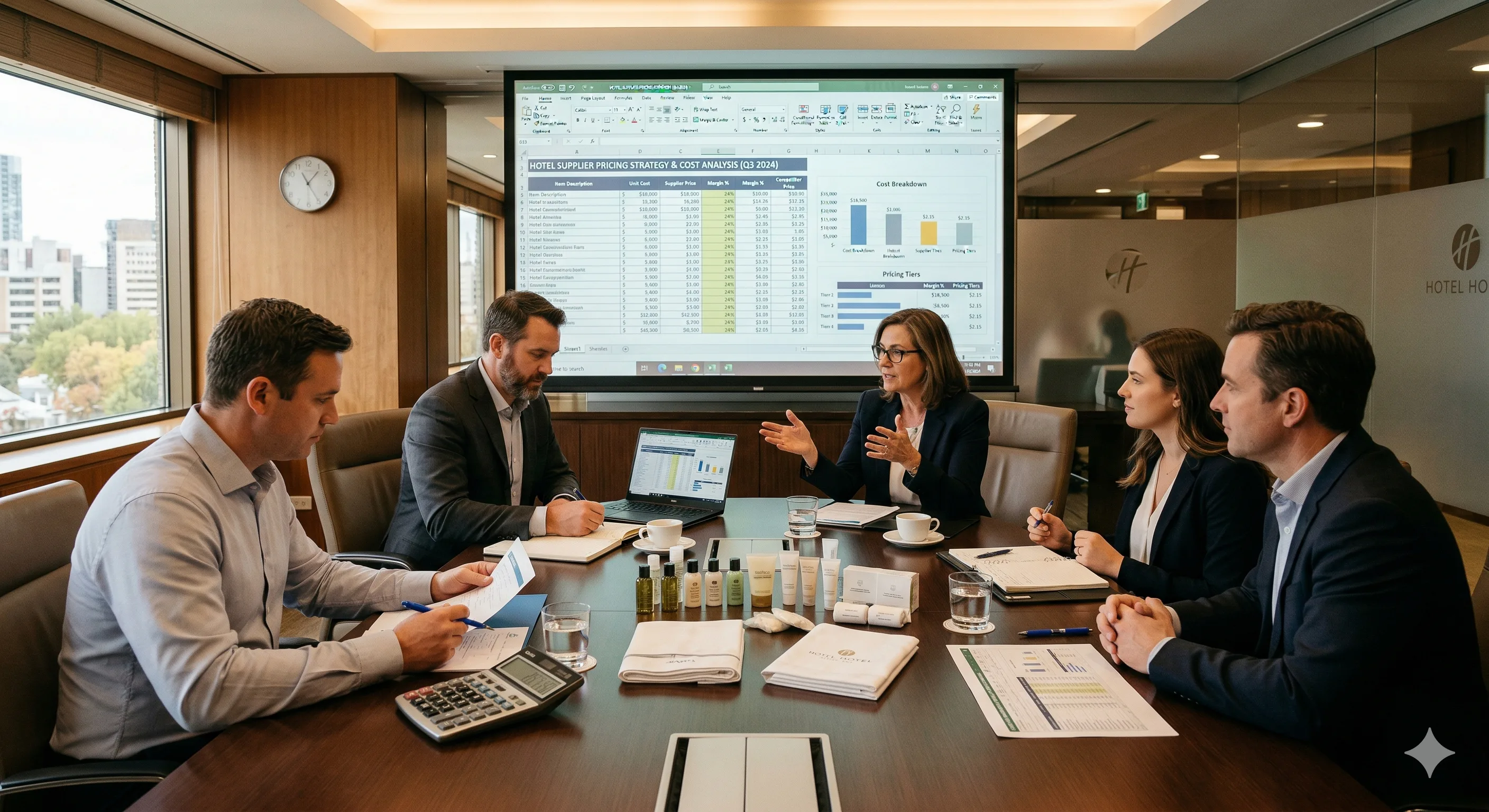
Strategy 8: Pricing Architecture That Wins POs
Pricing is the most overlooked lead-generation lever in hotel supply. Suppliers who lose deals on price are usually losing on pricing presentation, not pricing itself. A flat per-unit quote against a competitor’s tiered, value-broken-down proposal will lose 70% of the time even when the per-unit number is identical.
Five pricing models work in hotel supply: (1) volume-tiered pricing for chain rollouts, (2) project-based pricing for full FF&E packages, (3) subscription pricing for amenity refresh programs, (4) value-based pricing for specification-driven luxury work, and (5) consignment/landed-cost pricing for international buyers. The right model depends on your category, channel, and whether you’re selling direct or through procurement firms.
For the full pricing-model breakdown including when each one wins and how to architect proposals, see Pricing Strategies for Hotel Suppliers: How to Compete on Value.
Strategy 9: Account-Based Selling for Top Brands and Management Companies
Treating Marriott as one account is a mistake. There are ~30 distinct buying centers inside Marriott (brand-level FF&E specifiers, regional procurement teams, individual property GMs at full-service hotels, owner groups for franchised properties). Account-based selling for hotel supply means mapping the buying centers inside each target chain or management company, identifying the named individuals, and running parallel multi-touch outreach across each.
The hotel suppliers who break into top-30 chains do it through ABM, not broadcast outbound. They invest 3-6 months mapping the account, build relationships with 2-3 named contacts inside each buying center, host design-firm dinners, and time their pitches to the brand’s PIP cycle. ROI takes 6-18 months to show, but a single named-account win at a top-tier chain typically pays back the entire ABM investment 5-10x.
Strategy 10: Design-Firm and Procurement-Agency Relationships
In luxury hospitality, the spec decision often happens outside the hotel. Design firms (HBA, Wilson Associates, Gettys Group, Champalimaud, Yabu Pushelberg) and procurement agencies (Benjamin West, Purchasing Management International) specify products and write the spec sheets that procurement teams then bid out. The supplier whose product is in the spec wins regardless of price competition.
Building design-firm relationships is the single highest-leverage activity in luxury FF&E sales. It looks like: showroom visits, sample programs, exclusivity arrangements on key SKUs, hosted dinners with design teams, and being the supplier who responds within 4 hours when a designer needs an obscure spec confirmed at 8pm before a client review. Suppliers who institutionalize this — assigning a dedicated design-firm relationship manager — outsell competitors 3-5x in the luxury segment.
Phase 4: Compounding — Make Each Win Generate the Next
Strategy 11: Referral and Partnership Programs
Hotel procurement is a small world. The director of purchasing at a Four Seasons today is at a Six Senses next year, and they bring trusted suppliers with them. Engineered referral programs — formal incentive structures for existing clients to refer adjacent properties, paired with light-touch partnership programs with complementary suppliers (lighting + furniture, textiles + amenities) — produce some of the highest-converting leads in B2B hotel supply.
The structure that works: 5-10% revenue share on referred deals (paid quarterly), an annual partnership summit with 3-5 complementary suppliers (cross-promote each other’s catalogs to shared clients), and a “favorite supplier” certification you can offer to design firms in exchange for warm intros. Referred leads in hotel supply convert at 3-4x the rate of cold outbound.
Strategy 12: Multi-Channel Digital Marketing for Distributors
For hotel supply distributors and multi-line representatives, single-channel marketing is a losing game. The economics only work when SEO, content, paid search, retargeting, email nurture, and social are running simultaneously and feeding each other. A content piece ranks on Google → drives traffic → traffic gets retargeted on LinkedIn → LinkedIn ad drives a download → download triggers an email nurture → nurture surfaces a sales-qualified lead.
The full channel-by-channel breakdown for distributors — with realistic CAC by channel, ROI timelines, and the tactical playbook for running it on a $5K, $20K, or $100K monthly budget — is in Digital Marketing for Hotel Supply Distributors.
How to Sequence the 12 Strategies
Don’t try to launch all twelve at once. The sequencing that works for most hotel suppliers:
Months 1-3 (foundation): SEO audit, primary keyword strategy, and 4-6 cornerstone content pieces. LinkedIn profile rebuild for the founder and top 2 sales leaders. Verified ICP contact list and a tight outbound sequence (Strategies 1, 2, 4, 6).
Months 4-6 (engage): Layer in AI signal monitoring so trigger-based outreach replaces blind outbound. Begin design-firm and procurement-agency outreach. Pricing architecture review (Strategies 5, 8, 10).
Months 7-9 (compound): ABM motion against your top 10 target chains/management companies. Referral program rollout to existing clients. Brand-building cadence (consistent publishing, founder thought leadership, podcast appearances) (Strategies 3, 9, 11).
Months 10-12 (scale): Multi-channel digital marketing for distributors and high-volume product lines. Strategic trade-show selection for next year’s calendar. Performance review and reinvestment in the channels showing the highest ROI (Strategies 7, 12).
The suppliers who execute this sequence consistently for 12 months see qualified pipeline grow 3-5x year-over-year — and more importantly, see CAC drop as inbound and trigger-based channels start replacing cold outbound.
What to Skip
A short list of B2B lead-gen tactics that don’t work in hotel supply, despite consultants pitching them:
- Mass-volume cold email to scraped procurement lists. Domain reputation damage is irreversible. Targeted, trigger-based outbound only.
- Generic LinkedIn ads to “hospitality professionals.” Too broad. Use account-based ads against your top-50 target chains instead.
- Webinar series without a specific procurement audience. Hotel buyers don’t sit through generic webinars; they read specification guides.
- Print advertising in trade publications. ROI hasn’t worked in hotel supply since 2018. The same budget in SEO + content compounds 10x harder.
- Buying email lists from B2B data resellers. The data is stale, the addresses are catch-alls or role-based, and your domain reputation pays the price for someone else’s outdated database.
The Honest Truth About B2B Hotel Supply Lead Generation
Hotel supply is a long-cycle, project-driven business. Lead generation isn’t a quarterly sprint — it’s a 12-36 month compounding investment. Suppliers who quit at month 6 because “SEO isn’t working yet” miss the inflection point at month 9-12 when the first content pieces start ranking, the design firms start specifying, and the AI signal monitoring matures into a steady flow of trigger-based opportunities.
The suppliers winning aren’t doing anything magical. They’re running 6-8 of these strategies consistently for 18-24 months, measuring what works, killing what doesn’t, and reinvesting in the channels showing compounding returns. The hotel supply industry is still early in its digital transformation — the gap between digitally-mature suppliers and brochure-ware competitors is the widest it has been in twenty years. The window to compound that advantage is open now.
Pick 4-6 strategies that match your category, your budget, and your team’s existing strengths. Sequence them over the next 12 months. Then run them long enough to actually see the curve bend.
Want help operationalizing AI signal monitoring (Strategy 5) for your product category? InnLead.ai is purpose-built for hotel product suppliers. Our 12-agent system tracks renovation signals across 2,800+ properties in 25+ countries, matches them to your catalog, and delivers verified procurement contacts to your inbox. Learn more or read the FAQ.
Use these related guides to keep moving through the same procurement, sales, or market research thread.
Skip the Manual Work
InnLead.ai's 12 AI agents find hotels buying your products, identify procurement contacts, and book meetings -- automatically.
Get Early Access